


The 4 Cs of Diamonds
Every diamond is one of a kind, but its beauty and value are defined by four key factors — known as the 4 Cs: Cut, Color, Clarity, and Carat. Understanding these will help you find the perfect diamond for your taste and budget.
Color
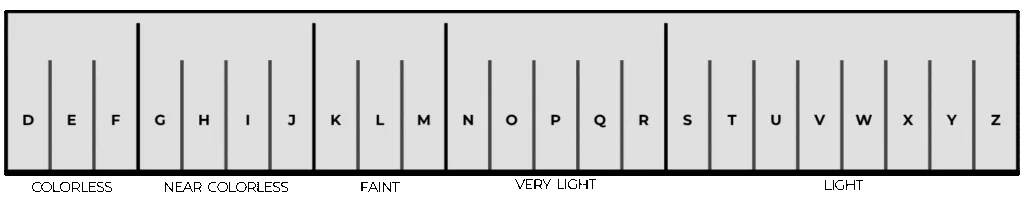
A diamond’s color grade measures how colorless it is from D (colorless) to Z (light tint). The more colorless the diamond, the rarer and more brilliant it appears. At JDH, we recommend D–H grades for a bright, beautiful sparkle.
Clarity
Clarity describes the tiny natural features called inclusions. While most are invisible to the naked eye, higher clarity grades mean fewer imperfections and a cleaner look. JDH diamonds are carefully selected to ensure eye-clean brilliance.
Cut
Cut determines how well a diamond reflects light. A perfect cut brings out fire, brilliance, and sparkle — the qualities that make diamonds truly shine. All JDH diamonds meet our precision-cut standards for maximum brilliance.
Carat
Carat weight measures a diamond’s size.While larger diamonds are rare and valuable, the ideal diamond balances size, cut, and quality. Our experts help you find the right carat size for your style and setting.
Diamond Education Scale

Measurements & Proportions
Diamond beauty also depends on its shape and proportions how each facet interacts with light.

The Table
Table — The Crown's Flat Facet
The table is the large flat facet on top of the diamond, forming the crown's centerpiece. It acts as a window, allowing light to enter and exit the stone.
A well-proportioned table maximizes the play between brilliance and fire, ensuring the diamond captures and reflects light beautifully from every angle.

The Crown
Crown — Upper Half of the Diamond
Thecrownsits above the girdle and includes the table and surrounding facets.
It acts like a prism — bending and dispersing light into the flashes of color (called “fire”) that diamonds are known for.
The crown’s angle affects how much brilliance you see: a shallow crown reduces sparkle, while a steep one can darken the stone.

The Girdle
Girdle — The Diamond's Widest Edge
Thegirdleis the thin perimeter separating the crown from the pavilion.
It’s where the diamond is held securely in its setting.
A girdle that’s too thin increases the risk of chipping, while one that’s too thick adds unnecessary weight and reduces brilliance.

The Pavilion
Pavilion — Light's Mirror
Thepavilionis the lower section beneath the girdle — it reflects light back through the top of the diamond.
The depth of the pavilion is crucial: if it’s too shallow, light leaks out of the bottom, making the diamond look dull; if too deep, light escapes through the sides, creating dark areas.

The Culet
Culet — The Diamond's Lowest Point
Theculetis the very tip at the bottom of the diamond.
In modern diamonds, the culet is either very small or nonexistent to maintain symmetry and brilliance.
A large culet can create a visible dark spot when viewed from above, reducing overall sparkle.

Total Depth
Depth — The Diamond's Proportions
A diamond’sdepth— the total height from table to culet — influences how light moves within the stone.
Perfect depth ensures that light entering from the top bounces off the pavilion facets and returns through the crown, maximizing brilliance.
Explore
Diamond Shapes

Cushion

Emerald

Heart

Marquise

Oval

Pear

Princess

Radiant

Round

Asscher
Beyond the 4 Cs
At Jewelry Depot Houston, we believe true diamond excellence goes deeper than just Cut, Color, Clarity, and Carat. Subtle details like fluorescence, symmetry, polish, proportions, and culet precision also influence a diamond’s beauty and performance. Here’s what you should know:
Culet
The culet is the tiny point at the very bottom of a diamond. Its size affects how light travels through the stone. A perfectly proportioned culet keeps light reflection balanced, enhancing sparkle and brilliance. If it’s too large, it can appear as a small dark spot when viewed from above which is why JDH diamonds are selected only with small or no culet for flawless light return.
Measurements
Diamond measurements reveal how proportionally the stone is cut. Even two diamonds with the same carat weight can look completely different if their proportions vary. A well-balanced diamond will appear larger, brighter, and more vibrant. At JDH, every diamond is measured for ideal proportions, ensuring it sparkles beautifully from every angle.
Fluorescence
Fluorescence refers to how a diamond reacts under ultraviolet (UV) light. Some diamonds emit a soft blue glow due to natural minerals. While fluorescence doesn’t affect how a diamond looks in normal lighting, it can influence price and appearance in rare cases. At JDH, our gemologists assess fluorescence carefully to ensure your diamond’s color and brilliance are never compromised.
Symmetry
Symmetry defines how precisely a diamond’s facets are aligned. Perfect symmetry allows light to bounce evenly through the stone, maximizing sparkle and fire. Diamonds with excellent symmetry are brighter and more visually appealing that’s why JDH only sources stones that meet excellent or very good symmetry standards, verified by trusted certification labs.
Polish
Polish reflects the craftsmanship behind each facet. A well-polished diamond has smooth, mirror-like surfaces that enhance light reflection and clarity. If facets are uneven or rough, brilliance is reduced. Every JDH diamond undergoes meticulous polishing to ensure it meets our exceptional surface finish standards, guaranteeing maximum shine.
Certified Diamonds
Every diamond atJewelry Depot Houstoncomes with anindependent certificationfrom leading gemological labs such asGIAorIGI.
This ensures transparency and verifies that your diamond’s cut, color, clarity, and carat meet the highest global standards